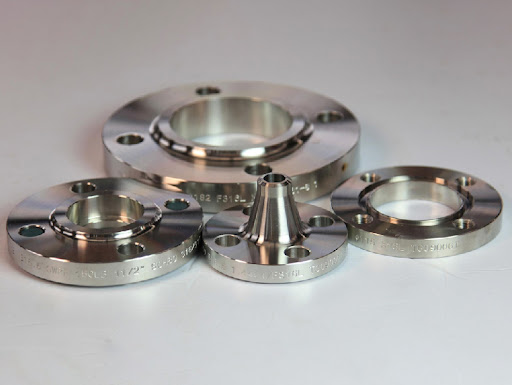
Flanges play a crucial role in piping systems, providing secure connections between pipes, valves, pumps, and other equipment. Different types of flanges are designed for specific applications, each offering unique advantages. Understanding these types helps in selecting the right flange for your project, ensuring safety, efficiency, and reliability.
The Six Main Flange Types
Weld Neck Flanges
Weld neck flanges have a long, tapered hub that is welded to the pipe, providing strong and reliable connections. The smooth transition from flange thickness to pipe wall thickness offers excellent strength under high pressure and temperature.
Applications: High-pressure and high-temperature applications such as oil and gas, chemical processing, and power generation.
Slip-On Flanges
Slip-on flanges are designed to slide over the end of a pipe and are then welded in place. They are easier to install and align compared to weld neck flanges but are less robust.
Applications: Low-pressure, low-temperature applications where quick installation and alignment are essential.
Blind Flanges
Blind flanges are used to close off the ends of piping systems, valves, and pressure vessel openings. They do not have a bore and are typically used for inspection and maintenance purposes.
Applications: Piping systems that require periodic inspection, maintenance, or future expansion.
Socket Weld Flanges
Socket weld flanges have a socket where the pipe is inserted and then welded. They provide a smooth bore and better flow characteristics compared to other flanges.
Applications: Small-diameter, high-pressure piping systems.
Threaded Flanges
Threaded flanges have a threaded bore that matches the external thread on the pipe. They can be assembled without welding, making them suitable for systems where welding is not feasible.
Applications: Low-pressure, low-temperature applications, and systems handling flammable materials where welding is a risk.
Lap Joint Flanges
Lap joint flanges are used with a stub end fitting. They are not welded or fixed to the pipe, allowing for easy disassembly and alignment.
Applications: Systems that require frequent disassembly for inspection or maintenance.
Frequently Asked Questions
Q: What is the main difference between weld neck and slip-on flanges?
A: Weld neck flanges have a long, tapered hub that provides strong connections, suitable for high-pressure applications. Slip-on flanges are easier to install but generally used for low-pressure applications.
Q: Can blind flanges be used in high-pressure systems?
A: Yes, blind flanges can be used in high-pressure systems to close off the ends of piping systems, valves, and pressure vessel openings.
Q: How do threaded flanges differ from socket weld flanges?
A: Threaded flanges have a threaded bore that allows them to be screwed onto the pipe without welding, ideal for low-pressure systems. Socket weld flanges insert the pipe into a socket then weld it, providing a strong connection for high-pressure systems.
Q: What are the common materials used for manufacturing flanges?
A: Flanges are commonly made from stainless steel, carbon steel, alloy steel, and sometimes exotic materials like Inconel or Hastelloy, depending on the application.
Q: Why are lap joint flanges preferred in systems requiring frequent disassembly?
A: Lap joint flanges are not welded or fixed to the pipe, allowing for easy disassembly and alignment, making them ideal for systems that require frequent inspection or maintenance.
Q: Are there specific standards that govern flange dimensions and types?
A: Yes, flange dimensions and types are governed by standards such as ASME, ANSI, DIN, and JIS, which provide guidelines to ensure compatibility and safety.
Q: How can I ensure the flange I select is suitable for my application?
A: Consider pressure rating, temperature, material compatibility, and the specific requirements of your piping system. Consulting with experts or referencing industry standards also helps.
Q: What is a pressure rating, and why is it important for flanges?
A: A pressure rating indicates the maximum pressure a flange can withstand. It's crucial for ensuring the flange can handle your system's operating conditions without failure.
Q: Can flanges be customized for specific applications?
A: Yes, flanges can be customized to meet specific requirements, including unique dimensions, materials, and pressure ratings. Customization is common for specialized applications.
Conclusion
Selecting the right type of flange is crucial for ensuring the integrity and performance of a piping system. Each type offers distinct advantages and is suitable for specific applications. Understanding these differences leads to safer and more efficient operations.